By: Ing. María José Rodríguez
Recently, at a mining convention, I observed how a panelist enthusiastically explained the advantages of using “digital twins” in mining operations. However, the expressions of some renowned attendees clearly reflected confusion. It was almost reminiscent of those moments when legal interpretations are needed, and lawyers respond in Latin. For that reason, it is essential to clarify basic definitions—and above all, to explain them in simple terms.
- Let’s start from the beginning: ¿What are Digital Twins?
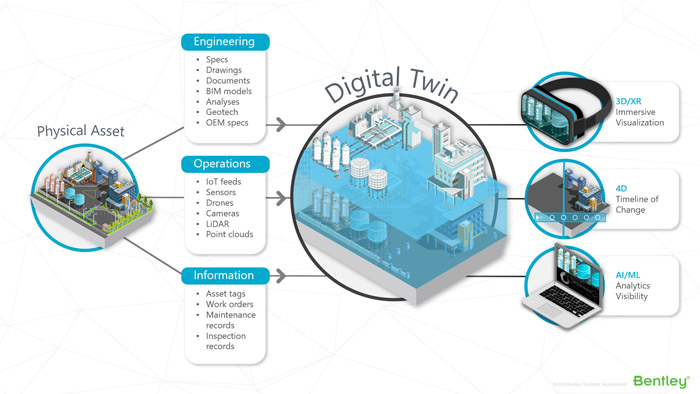
Digital Twins (DTs) are virtual replicas of physical systems, objects, or processes that maintain a two-way, real-time connection with their physical counterparts. This technology allows the mapping of functions, behaviors, and structures of real entities within virtual environments.
For example, a virtual model of an aircraft can be used to simulate flights, optimize routes, and reduce fuel consumption[1].
According to Digital Twins and Applications[2], a fundamental aspect of this technology is the bidirectional connection between the DT and its corresponding physical object, so that changes occurring in one are reflected in the other in real time. Likewise, the DT continuously mirrors the state and behavior of the physical object and is constantly updated through data gathered from sensors, smart tools, and other sources.
These extraordinary features make it possible to create a model that is more synchronized with reality—capable of simulating scenarios, optimizing operations, and predicting results—thus driving evidence-based decision-making[3].
Since their conception as tools for representing isolated assets, DTs have evolved into interconnected intelligent ecosystems that integrate Artificial Intelligence (AI), the Internet of Things (IoT), edge computing, and machine learning, shaping the digital infrastructure of the new industrial era.
- Main functions:
The main function of digital twins is to bridge the gap between the physical and digital worlds, providing a powerful tool to understand and manage complex systems.
Their functions can be summarized in four main categories:
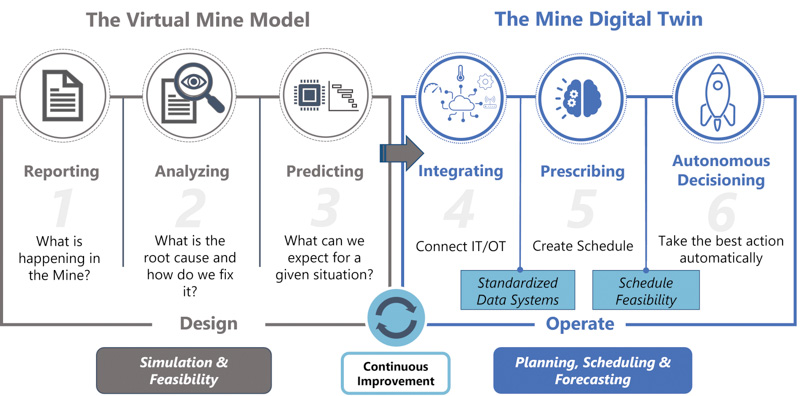
- Capture (Descriptive): Collects real-time data from sensors, IoT, or control systems to show the current state of an asset.
- Analyze (Diagnostic): Compares the actual state with the ideal model to detect deviations and generate automatic alerts or reports.
- Predict (Predictive): Runs simulations and machine-learning models to forecast outcomes, optimize resources, or prevent failures.
- Act (Prescriptive): Applies artificial intelligence algorithms and autonomous control to automatically implement the best strategy according to defined objectives.
Some examples of these functions include:
- In 5G networks, Digital Twin Networks diagnose connectivity failures and anticipate packet loss before users are affected.
- In the Novel Generation Modelling Platform (NGM) [4], digital twins operate within a closed-loop control system, adjusting industrial process variables in real time.
- In mining, DTs allow the simulation and optimization of extraction processes, reducing operational risks and predicting equipment or structural failures in underground operations.
Other complementary support functions of DTs include data integration, advanced visualization, traceability, governance, and sustainability.
- Application areas:
The expanding range of Digital Twin applications confirms their relevance across multiple complex industries—particularly within the framework of digital transformation (Industry 4.0).
According to Sun et al. (2024), the main sectors currently adopting DT technology include:
- Manufacturing: Crucial for predictive maintenance, quality control, and supply chain optimization. For example, Siemens uses digital twins to simulate and optimize production processes, resulting in significant improvements in efficiency and product quality.
- Aerospace: Used to predict performance and maintenance needs of aircraft and satellites.
- Healthcare: Improves operational efficiency, predictive maintenance, and the overall quality of the healthcare environment[5]. For instance, through the simulation and control of temperature, humidity, and lighting in hospital operating rooms.
- Energy: By creating digital replicas of energy assets, operators can predict maintenance needs, improve efficiency, and reduce downtime.
- Agriculture: Applied in precision agriculture to monitor crop health, soil conditions, and weather patterns, helping farmers make informed decisions on irrigation, fertilization, and harvesting.
- Construction: The integration of DT with blockchain enables the creation of an immutable record of design, construction, and maintenance data, facilitating interoperability among stakeholders in the AEC-FM ecosystem (Architecture, Engineering, Construction, and Facility Management).
- Supply Chain: The simulation of different logistical scenarios allows for improved delivery times, cost reduction, and greater resilience.
- Water Management: Used in treatment and distribution systems to monitor water quality, predict pipe failures, and optimize overall network performance.
- Telecommunications: Enables self-regulating networks capable of anticipating demand, reducing latency, minimizing connection drops, and optimizing energy consumption.
Thus, it is clear that digital twins have become the common language of digital transformation, enabling convergence among traditionally isolated sectors.
- Conclusions:
- As noted above, Digital Twin technology is a powerful tool characterized by real-time connectivity and its proven ability to predict and optimize complex systems. In other words, it bridges the gap between the physical and digital worlds, providing an exceptional means to understand and manage systems.
- From hospitals to factories, mining operations, ports, construction firms, and telecommunications companies, all must consider the profound impact of this technology, which goes beyond technical efficiency to redefine the relationship between humans, machines, and the environment, ushering in a new era of operational intelligence and sustainability.
- Although there is still progress to be made, the continuous development of DTs—and their integration with emerging technologies such as blockchain, artificial intelligence, and edge computing—will drive their widespread and effective adoption across multiple sectors.
- In the journey from data to impact, digital twins embody the transition from representation to action: they are the intelligent mirror of the physical world, where every bit reflects a decision that transforms reality.
For further information, please contact us at: maria.rodriguez@kaitekiregulacion.pe.

Ing. María José Rodríguez
Jefa de Transformación Digital
maria.rodriguez@kaitekiregulacion.pe
[1] Simplifying the example as much as possible for illustrative purposes, having a computer file backup is like taking a “snapshot in time” and nothing more. Having those files stored in the “cloud” means they are updated in real time, but still, that’s all. Having a digital twin, however, means having the AVATAR of your operation, where you can run test processes, for example, to make your company more efficient (without halting production) and avoid additional costs. The digital twin is like an intelligent mirror that reflects reality in real time, but with one major difference: this twin learns and acts, based on your real data, and predicts what is going to happen. And that’s only the beginning.
[2] Inaugural Editorial—Digital Twins and Applications (Sun et al., 2024)
[3] A digital twin is a living model that breathes data. For example, its application in designing evidence-based public policies is extraordinary. In this way, in a chaotic megacity such as Lima, it would be possible to create a constantly updated “model” that integrates real-time traffic information, allowing planners to test policies or infrastructure projects before implementing them in the real world.
[4] Promoting Digital Twin Technology Application for Process Industry (Zhang et al., 2024)
[5] Towards a Healthier Hospital Environment: The Role of Digital Twins in Achieving Optimal Environmental Comfort—Cumo et al., 2025.