By: Eng. María José Rodríguez
Following the recent approval of the National Data Governance Strategy 2026–2030 through Ministerial Resolution No. 049-2026-PCM (February 2016), which recognizes that data governance and management across Public Administration entities currently exhibit an incipient and heterogeneous level of maturity—reflected in institutional fragmentation, the absence of formal strategic approaches, and weaknesses in data quality, interoperability, security, and traceability, with more pronounced gaps at the subnational level—we must ask: where does Peru stand in the use of BIG DATA for public policy formulation?
This concern becomes even more relevant in periods such as the present, where greater analysis and objectivity are required for decision-making. With this in mind, let us examine what BIG DATA entails:
- ¿What is BIG DATA?
In the European Union, BIG DATA is defined as large volumes of data generated at high speed from a wide variety of sources. These data may be created by individuals or generated by machines, such as sensors collecting climate information, satellite images, digital photos and videos, purchase transaction records, GPS signals, among others. It spans multiple sectors, from healthcare to transport and energy. Value creation across the different stages of the data value chain will be essential for the future knowledge economy[1]. In Peru, CEPLAN[2] defines BIG DATA as a fundamental element of digital transformation, both in the public and private sectors. It enables the capture, storage, and processing of large volumes of data, allowing the identification of patterns and discovery of correlations that support decision-making—whether to improve customer experience and operational efficiency or to more effectively address social challenges. Its positive impacts are summarized, in a conservative manner, in the following table:
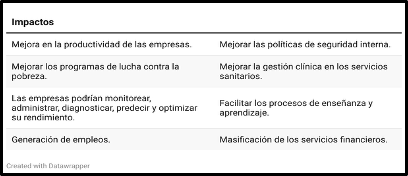
Source: CEPLAN Observatory
An example is the use of BIG DATA to determine the number of people and the transportation routes they require to commute to work, thereby enabling the planning of metro lines needed in a chaotic city like Lima—without resorting, as in the past, to time-consuming door-to-door surveys. Similarly, it can be used to identify the most effective commercial strategies for social media platforms (such as Instagram) during specific seasonal campaigns, among other applications. In both cases, data are extracted, processed, and validated to ensure that no method exists to identify individuals; they are then aggregated or anonymized so they can support evidence-based public policy or business decisions. In other words, not infallible, but more grounded.
In this way, BIG DATA has become a fundamental tool across all sectors of the economy, and particularly a core instrument for public policy formulation. Its remarkable ability to collect, store, and analyze large datasets enables the generation of valuable insights about markets, customers, and their preferences, leading to more informed decision-making.
In this new scenario, according to World Bank[4] reports, it is noted that, while digitalization has become a driver of innovation, economic growth, and job creation, it is also observed that in low-income countries, vulnerable populations and small businesses have been left behind. Meanwhile, transformative digital innovations, such as artificial intelligence (AI), have accelerated in higher-income countries, thereby widening existing gaps. Therefore, one of the World Bank’s objectives is to support the formulation of evidence-based policies and to encourage action among the public and stakeholders, both internal and external.
From this perspective, while the specialized literature consistently emphasizes that public policies should move away from any form of “magical thinking” and be grounded in concrete evidence, there have nevertheless been clear examples of “anecdote-based regulation.” In this context, BIG DATA emerges as a powerful tool to support evidence-based policymaking—leading to the idea that “data kills narrative.” If this is the case, it is worth examining the current state of effective BIG DATA use in Peru.
- BIG DATA IN PERU
In line with international regulatory trends, Peru enacted the Digital Trust Framework through Urgency Decree No. 007-2020 (dated January 8, 2020), whose Article 12 defines data as strategic assets:
“12.1 Public entities and private sector organizations manage data—particularly personal, biometric, and geospatial data—as strategic assets, ensuring that they are generated, shared, processed, accessed, published, stored, preserved, and made available for as long as necessary and appropriate, taking into account information needs, ethical use, transparency, risks, and strict compliance with regulations on personal data protection, digital government, and digital security.
12.2 Public entities and private sector organizations promote and ensure the ethical use of digital technologies and the intensive use of data, such as the Internet of Things, artificial intelligence, data science, analytics, and the processing of large volumes of data.”
It is worth highlighting that the Regulation approved by Supreme Decree No. 126-2025-PCM promotes ethics across all stages of the design, development, implementation, and use of digital technologies, as well as the responsible use of data, with the aim of contributing to citizens’ well-being, generating public value, ensuring human-centered and transparent scientific and technological progress, and safeguarding fundamental rights as established in the Political Constitution of Peru and international human rights treaties (Article 39).
It also sets out key provisions, including: (i) data quality (Article 41), covering aspects such as completeness, conformity, consistency, non-duplication, integrity, and accuracy; and (ii) the National Data Center (Article 42), conceived as a digital platform managed by the Presidency of the Council of Ministers (PCM), within the framework of Article 13 of Urgency Decree No. 007-2020. This platform includes, among other capabilities, data storage, processing, analytics, data science, and data and information analysis to support evidence-based decision-making, subject to conditions, criteria, and procedures established by the Secretariat of Government and Digital Transformation (SGTD-PCM) through a formal resolution.
In Spain, the promotion of BIG DATA has been pursued through the España Digital initiative, whose latest version is España Digital 2026. This strategy emphasizes the need to transition toward a data-driven economy while ensuring security and privacy, with the goal that at least 25% of companies will be using AI and BIG DATA within five years. To achieve this, the plan outlines several key targets: (i) advancing the digitalization of public administrations (2025 target: 50% of public services available via mobile apps); (ii) accelerating business digitalization, with particular focus on micro-SMEs and startups (2025 target: e-commerce accounting for 25% of SME business volume); (iii) fostering the transition to a data-driven economy, ensuring security and privacy while leveraging AI opportunities (2025 target: 25% of companies using AI and BIG DATA); and (iv) safeguarding citizens’ rights in the new digital environment (2025 target: a national charter on digital rights), among others.
The key question raised is whether the measures proposed to achieve the objectives of a “data-driven economy” are sufficient, in light of the measurable targets set out in Peru’s National Digital Transformation Policy to 2030, or in initiatives such as Spain’s España Digital project, among others.
From the perspective of BIG DATA use in the public sector, there is an interesting case study. In South Korea, rapid economic growth revealed a disproportionate development across regions. In response, balanced development strategies were implemented through regulatory measures that led to the relocation of central administrative institutions to Sejong-si, which was built as an administrative capital based on a top-down approach using public BIG DATA. The results showed that, despite the government’s efforts, the population continued to concentrate in major metropolitan areas, and the economic gap between regions did not decrease[5]. This is an interesting example of how BIG DATA can support the formulation of public policies, as well as assess their effectiveness—or lack thereof—going beyond traditional statistical data.
“Big data is not simply large-scale data but contains specific information about the activities of individuals and companies. Therefore, it can be usefully used for multidimensional analysis that is difficult with existing statistical data. There is a growing social consensus on the high value of using such big data, and a consensus is also being formed that it can be usefully used in the establishment and implementation of national land planning or balanced national development policies (…) In other words, through public big data, it is possible to make a comprehensive diagnosis on regional conditions, such as the degree of development, potential capacity, and the lives of residents, and to analyze the effects of balanced development policies.” [6]
The same authors, Yoo, Y. and Choi, S. (2022), in relation to the South Korea case study, argue that—unlike traditional statistical data—BIG DATA exists in raw form and must therefore be processed and used in various ways depending on the need. They recommend that, to fully harness its benefits, it should be applied at a micro level. They further conclude, quite accurately, that BIG DATA can not only provide specific and practical insights that cannot be obtained from traditional statistical data, but can also be processed across different time and spatial units, enabling its effective use in the analysis and evaluation of public policies.
“There are a huge number of objects connected to the Internet at a tremendous speed around the world, and the various big data generated from them are opening a rich digital world. The applications of various information and communication technologies, including the Internet of Things (IoT), have increased tremendously, and people are using all kinds of IoT devices in their daily lives, generating huge amounts of big data. Advanced information and communication technologies are transforming common things into ubiquitous and pervasive computing, embedded devices, communication technologies, sensors, and Internet protocols to change people’s lives” [7].
For its part, the World Bank views BIG DATA use cases positively, defining it as a viable source of high-frequency, highly granular data that can provide, for example, deep insights into many aspects relevant to public policy formulation—such as human mobility and economic behavior—thereby better informing policy decisions. Today, the entire planet is captured daily by satellites (with the number of satellites orbiting the Earth having grown exponentially), with continuously improving quality and affordability. New public-private partnerships are also emerging, such as the Open Transport Partnership and the Workforce Data Initiative, aimed at making data from social networks, professional networks, mobile phones, and sensors available to policymakers.
In this context, the World Bank emphasizes that:
“The age of big data creates new challenges and opportunities. Governments need to develop strategies, tools and forms of engagement to better understand dynamic forces and respond accordingly. The solutions featured in this brief show how big data can tackle fraud and corruption, generate administrative savings, and improve service delivery and policymaking processes, making them smarter, more accountable and more responsive to citizen feedback[8].”
Clearly, the great paradox is that, as highlighted in the McKinsey Global Institute report (May 2011), titled “Big Data: The Next Frontier for Innovation, Competition, and Productivity,” the effective use of BIG DATA has the potential to transform economies, delivering a new wave of productivity and consumer surplus. At the same time, however, it calls on leaders to recognize both the opportunity and the strategic threat that BIG DATA represents.
From our perspective, the so-called “Technological Paradox” is no longer such. Indeed, with the rapid and continuous emergence of new technologies, turning a blind eye to what is happening in the world is no longer a sensible option. Accordingly, many countries—such as South Korea—have implemented strategies based on public BIG DATA (Smart Cities), giving them a significant advantage when it comes to designing and implementing new public policies.
In conclusion, it must be understood that BIG DATA is not neutral, and its effective use requires: (i) sound governance, (ii) robust infrastructure to enable data extraction, (iii) strong institutional capacity, (iv) a digital mindset, and (v) high data quality. This must be complemented by proper data analytics—understood as the application of a qualitative approach that enables more comprehensive and grounded diagnoses. In other words, data analytics should be conceived as an integrated process that combines quantitative and qualitative methods throughout the entire data lifecycle—from collection and processing to analysis and interpretation—rather than merely as the application of technological solutions.
IN SUMMARY:
- In the case of countries such as Peru, which face significant gaps in digital connectivity, it is necessary to increase investment in digital infrastructure (to ensure connectivity), while simultaneously adopting urgent and essential measures to establish a robust data governance policy (BIG DATA), as this can generate an economic “leap.” Full digital connectivity should not be a prerequisite for action, especially considering that even the most advanced countries in connectivity still face gaps.
- The concerns reflected in specialized literature regarding the risks of BIG DATA for human rights are diverse; however, the advancement of this technology cannot be halted nor its evident benefits ignored after a rigorous cost–benefit assessment. Therefore, it is preferable to leverage it as an ally in achieving economic development and as a foundation for technically sound, evidence-based public policies.
- From an economic perspective, data is not merely an input, but a catalyst that reshapes the traditional factors of production. Its impact increases exponentially with its accumulation and efficient use, generating increasing returns and network effects. For this reason, DATA should be considered the “fifth factor of production” alongside the traditional ones: (i) natural resources, (ii) labor, (iii) capital, and (iv) entrepreneurship.
- A sound BIG DATA policy should aim to improve the efficiency of data integration and management—not merely increase its volume. Data quality must be safeguarded in both the private and public sectors. In this way, it reinforces the principle that public policies should be grounded in evidence, for which the intensive use of BIG DATA is essential to their proper formulation.
- Public policy should promote integrated digital ecosystems, including data infrastructure, digital literacy, interoperability, and institutional data governance frameworks. On this basis, BIG DATA enables public policies to be not only reactive, but also predictive and granular.

Ing. María José Rodríguez
Operations Manager
maria.rodriguez@kaitekiregulacion.pe
[1] See: https://digital-strategy.ec.europa.eu/en/policies/big-data
[2] See: https://observatorio.ceplan.gob.pe/ficha/o22_2022
[3] See: https://www.ibm.com/think/topics/big-data-analytics
[4] See: Banco Mundial . 2024. Informe de tendencias y progreso digital 2023. © Banco Mundial. http://hdl.handle.net/10986/40970 Licencia: CC BY 3.0 IGO.
[5] Yoo, Y., & Choi, S. (2022). Effects of top-down balanced development strategies on regional balance: Evidence from public big data in Korea. Sustainability, 14(23), 16221. https://doi.org/10.3390/su142316221
[6] Idem. Pp 3.
[7] Idem. Pp 4.
[8] World Bank Group. (2017). Big data in action for government: World Government Summit workshop and high-level panel on big data for government. World Bank Group.